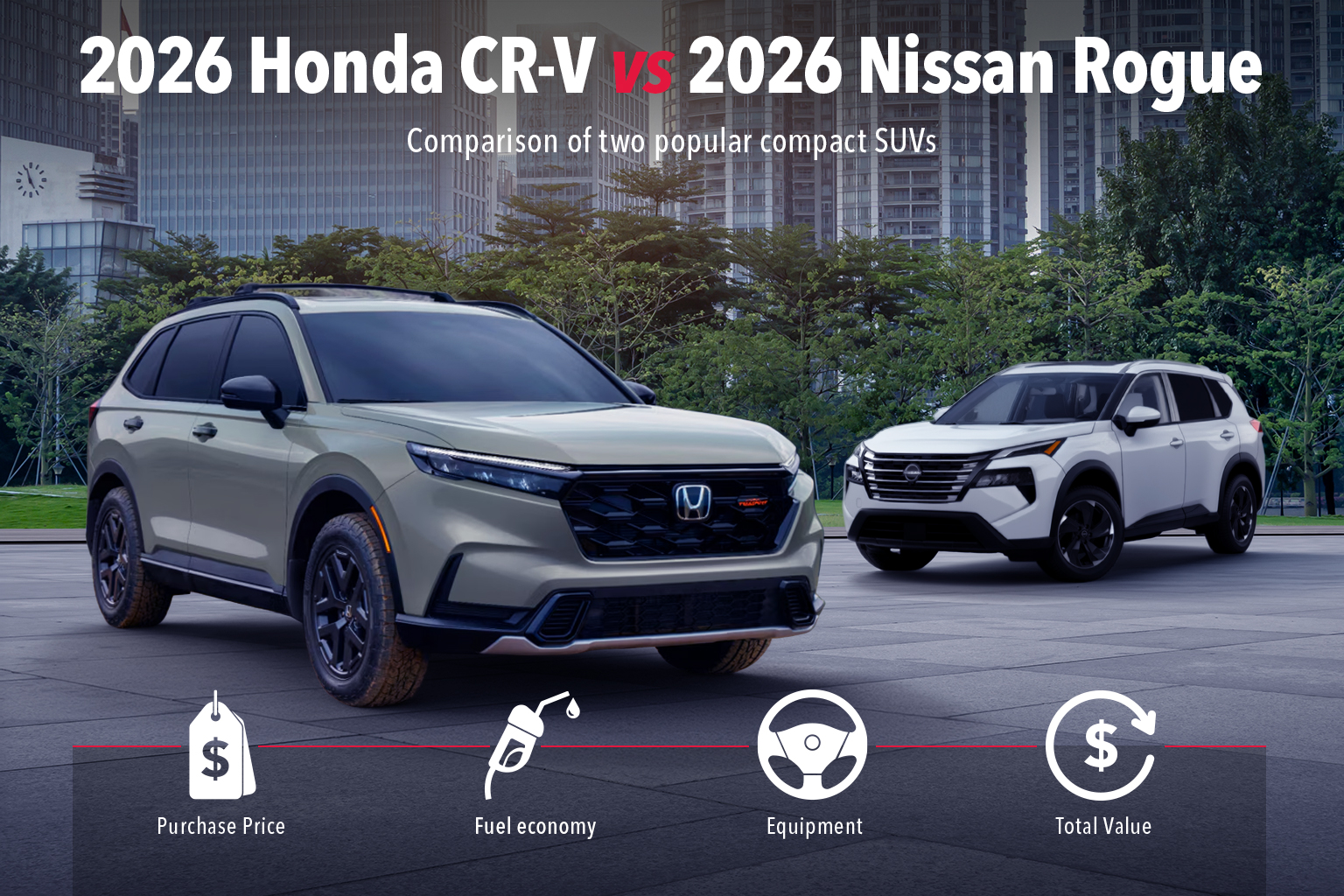
When comparing two popular compact SUVs like the 2026 Honda CR-V and the 2026 Nissan Rogue, the decision is rarely about looks alone. What really matters is overall value: reliability, real purchase cost, driving dynamics, everyday comfort, and resale value. On paper, both are appealing… but in real-world use, the CR-V stands out with a stronger, more cohesive package that generally delivers better long-term value.
Starting Price and Overall Value
The 2026 Honda CR-V has an estimated starting price of around $35,000, already including several standard safety and driver-assistance features. At comparable equipment levels, it’s rarely necessary to move up a trim to get a complete and well-balanced configuration.
The 2026 Nissan Rogue starts at a slightly lower price, around $34,000, but many equivalent features quickly become optional or are reserved for higher trims, pushing the real-world price to $36,000 or more for a comparable setup.
Powertrain and Mechanical Reliability
The 2026 Honda CR-V features a proven engine, recognized for its long-term reliability, smooth operation, and consistent everyday performance. Honda focuses on simple, durable, and well-mastered engineering.
The 2026 Nissan Rogue uses a mechanically more complex variable-compression turbo engine, with a more mixed long-term reliability track record.
Fuel Efficiency and Real-World Driving
In real-world conditions, the 2026 Honda CR-V delivers stable and predictable fuel economy, both in city driving and on the highway. The engine and transmission balance is well calibrated, with no surprises.
The 2026 Nissan Rogue may post competitive numbers on paper, but in everyday use (mixed driving, cargo load, winter conditions), fuel consumption tends to vary more.
Handling and Stability
The 2026 Honda CR-V stands out with a more balanced chassis, precise steering, and a reassuring driving feel, even at higher speeds or on the highway.
The 2026 Nissan Rogue offers acceptable comfort but delivers a less engaging driving experience and a less confident sense of control in certain situations.
Wheelbase and On-Road Comfort
Thanks to a longer wheelbase, the 2026 Honda CR-V provides improved stability, especially on long trips, while also enhancing rear-seat passenger comfort.
The 2026 Nissan Rogue remains comfortable in terms of overall dimensions, but its shorter wheelbase slightly limits the sense of space and highway stability.
Road Noise and Sound Insulation
The 2026 Honda CR-V benefits from more refined sound insulation: less road noise, fewer vibrations, and a quieter, more composed cabin at higher speeds.
The 2026 Nissan Rogue allows more road noise to filter into the cabin, especially on rough or uneven pavement.
Safety Technologies and Driver Assistance
Honda equips the 2026 CR-V as standard with a full suite of advanced safety technologies that are well calibrated and minimally intrusive.
At Nissan, some driver-assistance systems are effective, but their operation can be more abrupt depending on the trim level selected.
Long-Term Reliability and Resale Value
The 2026 Honda CR-V has historically maintained excellent resale value, thanks to its strong reliability reputation, controlled maintenance costs, and high demand on the used market.
The 2026 Nissan Rogue generally depreciates more quickly, particularly due to perceived uncertainty around the long-term durability of certain mechanical components.
Convinced?
Request your best price on your next 2026 Honda CR-V
If you’re looking for an SUV that checks the most important boxes — reliability, more stable handling, comfort, predictable ownership costs, and stronger resale value — the 2026 Honda CR-V clearly comes out ahead. It’s a choice you won’t regret.