The evolution of the Honda Civic tells the story of a car that grew alongside drivers, cities, roads, and seasons. From its first generation launched in the early 1970s to today’s modern models, the Civic has always kept the same mission: to offer a practical, enjoyable, reliable car designed for real life.
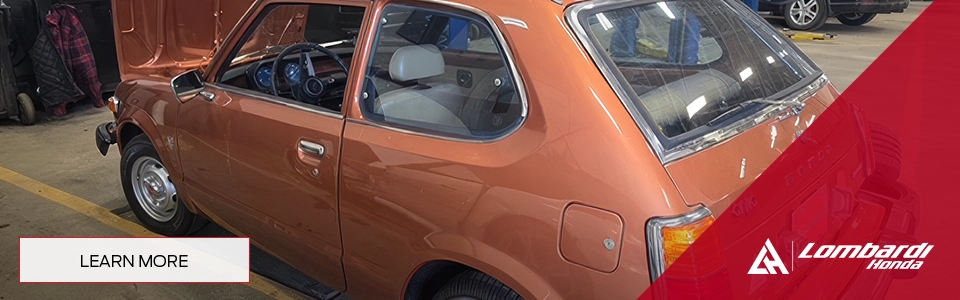
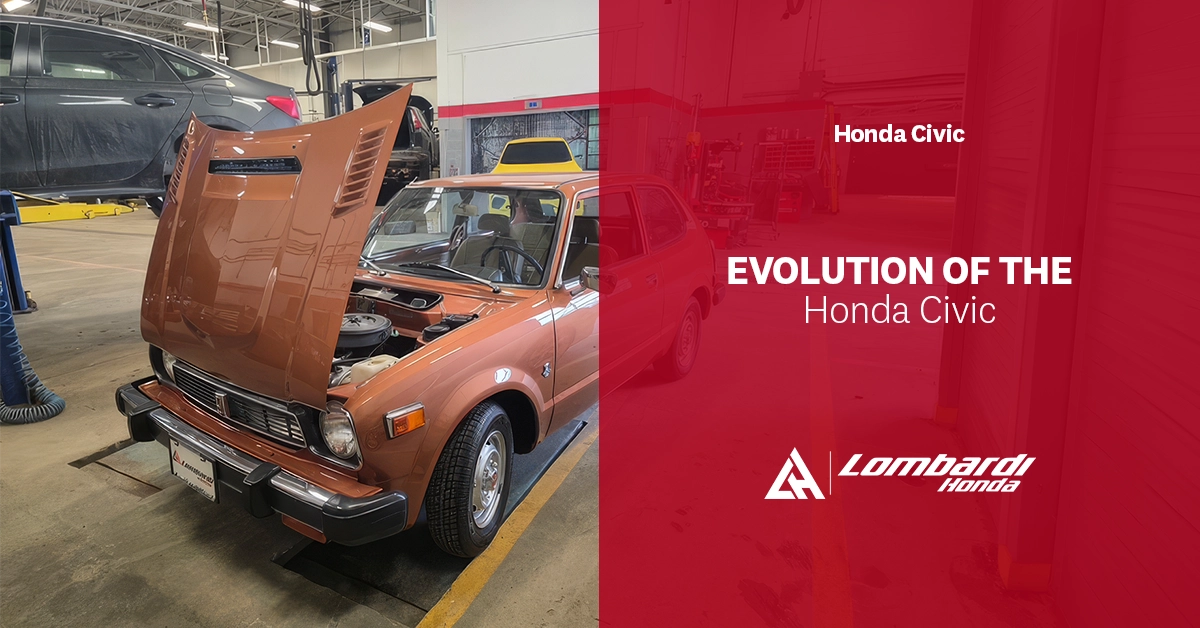
At Lombardi Honda in Montreal, this story takes on a very concrete form. A first-generation Honda Civic displayed at our dealership reminds us where this iconic model began. Looking at it, it quickly becomes clear why the Civic has marked so many generations: its simple format, compact look, and intelligent approach were already very modern for their time.
Suggested image to insert below the introduction:
First-generation Honda Civic displayed at Lombardi Honda in Montreal
Recommended alt text: First-generation Honda Civic displayed at Lombardi Honda in Montreal
The Evolution of the Honda Civic: A Simple Idea That Stood the Test of Time
The first Honda Civic was born in a very different automotive world. Cars were often heavier, less fuel-efficient, and less suited to urban driving. Honda took a different direction: creating a compact, lightweight, economical, and easy-to-live-with car.
This first generation was built around a clear idea: do more with less. Less bulk, less fuel consumption, but more relevance in everyday life. For a city driver, that meant a car that was easy to park, simple to drive, and versatile enough for daily trips.
Even today, this philosophy remains at the heart of the Civic. Although modern models are more spacious, more technological, and more powerful, the original intention remains very close to where it started.
The Civic has always focused on:
- easy-to-enjoy driving;
-
a practical format for both city and highway driving;
-
smart use of interior space;
-
reasonable fuel consumption;
-
a reputation for durability;
-
versatility suited to many lifestyles.
Lombardi Honda in Montreal: A First Generation That Draws Attention
At Lombardi Honda in Montreal, the first-generation Civic on display is more than just a collector’s car. It acts as a reference point. It lets you see, at a glance, how far Honda has come since the model’s beginnings.
Its short silhouette, hatchback design, simple lines, and compact dimensions recall a time when every detail had a purpose. Nothing was excessive. Everything seemed designed to make driving more accessible.
For a Montreal driver, this Civic easily brings to mind familiar scenes: a car weaving through residential streets, fitting into tight parking spaces, and accompanying trips between home, work, local businesses, and weekend outings.
The modern Civic has changed in scale, but it has kept the same ease of use that helped build its success.
From the 1970s to the 1980s: The Civic Becomes a True Compact Benchmark
The first-generation Civic arrived at a time when drivers were starting to look for more economical vehicles. The energy context of the 1970s made smaller cars more attractive, especially when they were well designed.
Honda quickly understood that the Civic could not simply be small. It had to be smart. Its front-wheel-drive layout, compact format, and well-used interior space helped it stand out.
With the following generations, the Civic gradually gained comfort, space, and maturity. It went from a small urban car to a complete compact vehicle, capable of meeting the needs of a solo driver, a couple, a small family, or a motorist who simply wanted a reliable and efficient car.
The 1990s: The Civic Gains Personality
For many drivers, the 1990s represent a defining period in Civic history. This was when the model became even more present in automotive culture. The Civic was no longer recognized only as a rational compact car. It also became associated with driving enjoyment, customization, and accessible performance.
Its design became more aerodynamic. Its handling became more refined. Certain versions strengthened its sporty character. The Civic found a rare balance: it remained practical for everyday use while offering a more dynamic feeling behind the wheel.
This dual personality explains much of its success. The Civic can be the car of a student, a professional, a young family, or an automotive enthusiast. It adapts without losing its identity.
The 2000s: More Comfort, More Safety, More Technology
By the 2000s, driver expectations had changed. People wanted a car that was more comfortable, better insulated, safer, and better equipped. The Civic followed this evolution without abandoning its DNA.
The cabin became more modern. Safety features became more important. Onboard technologies gradually became more present. The Civic evolved into a more mature compact, capable of competing with larger cars in several aspects of everyday comfort.
This was also the period when hybrid technology became part of the Civic’s history. Honda began integrating solutions designed to reduce fuel consumption and improve efficiency, while preserving a natural driving experience.
The Modern Civic: A Compact Car Adapted to Today’s Quebec
Today, the Honda Civic is no longer the minimalist small car of its early years. It has become a modern, well-equipped, and much more refined compact. Yet its role remains very clear: to support drivers in their daily lives with efficiency and confidence.
In Montreal and across Quebec, a Civic has to deal with several realities:
- urban streets and sometimes tight parking spaces;
-
busy highways such as Metropolitan Boulevard;
-
rapid temperature changes;
-
long drives to the Laurentians, the Eastern Townships, or Montérégie;
-
varied needs between the workweek, outings, leisure activities, and vacations.
The modern Civic responds to this reality with a balanced format. It remains compact enough for the city, yet comfortable enough for longer trips. It offers stable driving, a practical cabin, and powertrains designed for today’s lifestyle.
A More Powerful Civic, Yet Still Reasonable
The current Civic clearly illustrates the model’s evolution. Modern versions offer much more power, safety, and technology than the first generations. The 2026 Civic Sedan notably offers a 2.0-litre gasoline engine as well as a hybrid version producing up to 200 combined horsepower.
What makes this interesting is that Honda has not turned the Civic into an excessive car. Even with more power and more equipment, it remains a logical vehicle. It continues to focus on balance: sufficient performance, controlled fuel consumption, everyday comfort, and the reliability expected from a Honda.
That is exactly what makes the Civic’s evolution so consistent. The model changes with its time, but it never loses its common sense.
What the First Generation Still Teaches Us Today
The first-generation Civic displayed at Lombardi Honda reminds us of something important: a good car does not need to be complicated to be memorable.
It must meet real needs. It must inspire confidence. It must be pleasant to use, day after day. That was true in the 1970s. It is still true today.
When comparing this first Civic with current models, the evolution is clear:
- safety has become much more advanced;
-
interior comfort has greatly improved;
-
powertrains are more powerful and more efficient;
-
onboard technology is more present;
-
space and refinement have gained maturity;
-
hybrid technology is now part of the modern lineup.
But behind these transformations, the same intention remains: to create a compact car that makes life easier.
Why the Civic Remains Relevant in Montreal
In Montreal, a car has to be versatile. It must be able to handle city driving, take the highway, get through the seasons, and remain enjoyable in a sometimes demanding daily routine.
The Civic fits this reality well because it does not try to be too large, too complex, or too specialized. Instead, it offers a balance that speaks to many Quebec drivers: a practical format, reassuring handling, strong efficiency, and a solid reputation.
Whether it is for commuting to work, going out in Montreal’s neighbourhoods, weekend getaways, or longer family drives, the Civic remains an easy car to integrate into everyday life.
Rediscover the Civic at Lombardi Honda
At Lombardi Honda, we appreciate this continuity between past and present. The first-generation Civic displayed in Montreal recalls the beginnings of a model that became essential. Modern Civic models show everything Honda has added over time: comfort, technology, safety, performance, and efficiency.
For drivers choosing between a compact sedan, a hatchback version, or a hybrid powertrain, our team can help compare the options and choose the Civic that best matches your needs.
You can visit Lombardi Honda in Montreal, contact us for personalized advice, or schedule a test drive. The best way to understand the evolution of the Honda Civic is to move from looking at it to driving it.
FAQ – Honda Civic Evolution
1. When was the first Honda Civic launched?
The first Honda Civic was launched in 1972. It was designed as a compact, practical, and economical car suited to urban driving.
2. Why did the Honda Civic become so popular?
The Civic became popular because it combines several sought-after qualities: reliability, efficiency, enjoyable driving, a practical format, and a strong balance between comfort and everyday use.
3. Has the Honda Civic changed a lot since the first generation?
Yes. Today, it is larger, more powerful, safer, and much more technological. However, it keeps the same philosophy: offering a practical and well-designed compact car.
4. Is there a Honda Civic Hybrid?
Yes. The modern Civic is available with a hybrid powertrain, depending on the versions offered. This option combines performance, efficiency, and smooth driving.
5. Can I see a first-generation Civic at Lombardi Honda?
Yes. Lombardi Honda in Montreal displays a first-generation Honda Civic, creating a concrete link between the model’s beginnings and the modern Civic models available today.